Is 3D sculpting hard?
It is one of the easiest parts of 3D to start and one of the harder ones to get genuinely good at — and those two facts get mixed together into a reputation that puts people off before they try. This is an honest breakdown of which part is difficult, which part isn't, and roughly how long each takes.
By Mixos
The short answer
3D sculpting is easy to start and slow to master. The software takes an afternoon — you push a digital sphere around with a brush, and there are no vertices or edge loops to manage. What is hard is the same thing that is hard in drawing: seeing form and proportion accurately. Expect a recognizable result in a few weeks and genuinely good work in a year or two of regular practice. The tool is not the bottleneck; observation is.
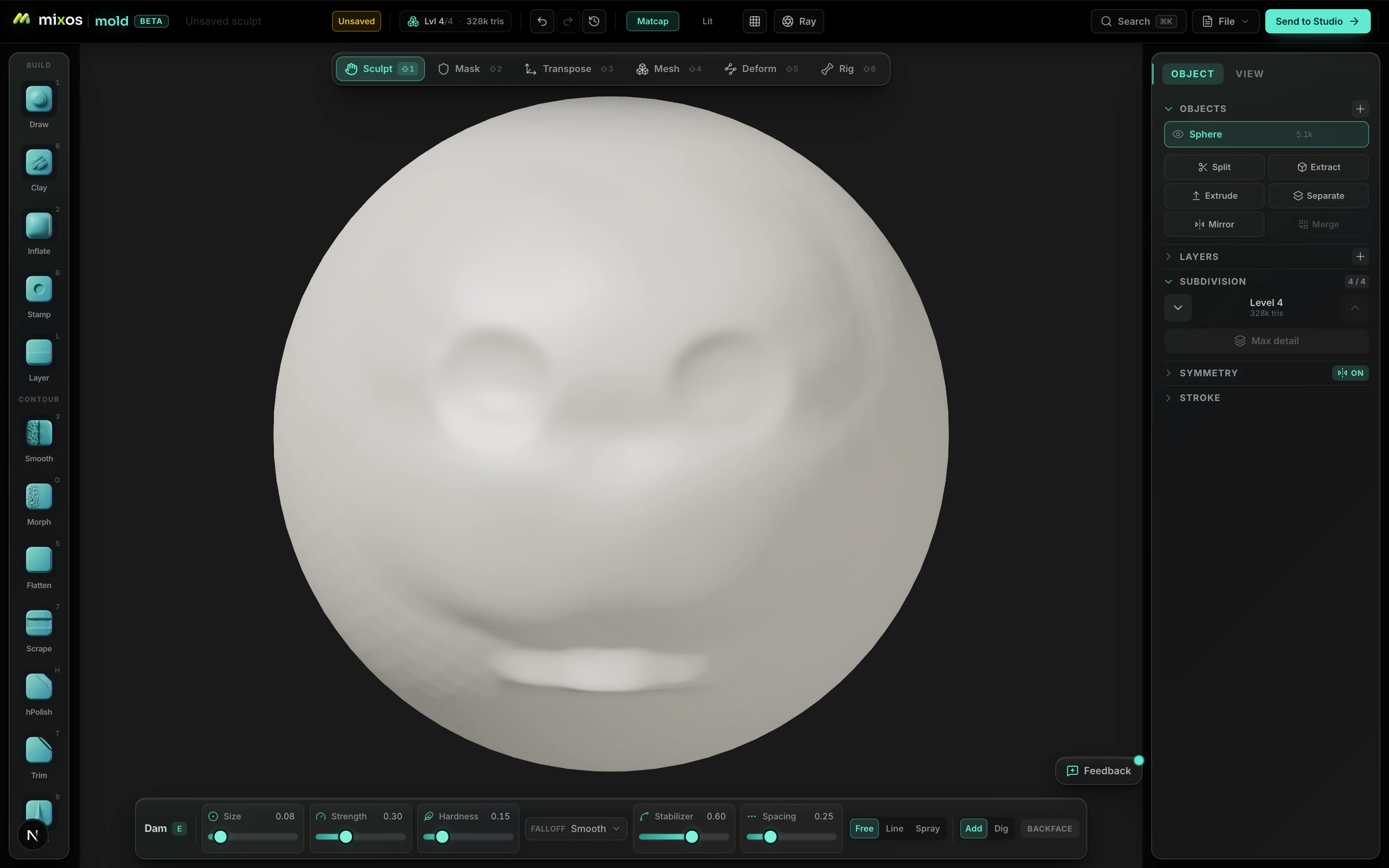
The software part is easy, and that surprises people
Compared with polygon modeling, sculpting is dramatically more approachable. Box modeling asks you to think about vertices, edges, faces, edge loops and topology before you can make a shape at all — you are essentially building a wireframe by hand and hoping it deforms well later. Sculpting asks you to push a lump of digital clay with a brush. The mental model is physical and immediate, and most people are productive with the core toolset within a single sitting.
The brush set looks larger than it is. Most sculpts are built almost entirely out of four: one to add mass, one to smooth, one to flatten, one to cut a crease. Everything else is a refinement you can pick up later. If a tutorial's brush palette is what's putting you off, ignore it — you can make a real sculpt with a quarter of it.
Where beginners genuinely do get stuck on software is topology: the sculpt stops responding to the brush, detail refuses to appear, the surface stretches into a mess when a shape is pulled far. This is not a skill problem, it is a resolution problem, and it has two standard fixes — subdivide to add detail evenly, or remesh to rebuild an even surface after a shape has moved a long way. Learning what those two do, and when to reach for each, removes most early frustration in one go.
The hard part is seeing, not clicking
The difficulty in sculpting is the same one that makes drawing hard: your brain edits what your eyes report. It tells you a face has two eyes, a nose and a mouth, and it does not tell you that the eyes sit halfway down the skull, that the ear runs from brow to nose-base, or that the widest part of the head is above and behind the ears. So beginners sculpt the symbol of a face rather than the shape of one, and the result reads as wrong in a way that is obvious to look at and hard to diagnose.
This is why the standard advice is to work from reference from the very first sculpt, and why 'sculpt what you see, not what you know' is repeated so often. It is not a beginner's crutch to be outgrown — professionals use more reference, not less. The single fastest improvement available to most beginners is putting a photo next to the viewport and actually comparing.
The second recurring failure is detailing too early. Skin pores on a head whose jaw is the wrong shape is time spent making an error more permanent. The reliable order is big masses, then secondary forms, then detail, and it feels slow precisely because detail is the enjoyable part. Sculpts that look wrong in an indefinable way are almost always proportion problems wearing a coat of detail.
How long it actually takes
Rough, honest brackets from how people generally progress. A first afternoon gets you comfortable with the interface and a shape that is unmistakably a blob. A few weeks of regular practice gets recognizable objects — a skull, a simple creature, a helmet — and the first sculpt you are not embarrassed by. Several months gets characters with believable proportion, and control over where detail goes. A year or two of consistent work gets to the level people describe as good.
That last bracket is the one worth being clear about, because it is where sculpting's reputation for difficulty comes from. It is a visual-art skill and it takes as long as visual-art skills take. But nothing about that first afternoon requires the year — the pleasant thing about sculpting is that the early progress is fast and visible, which is not true of every part of 3D.
Anatomy is the usual multiplier. You can sculpt without it, and everyone starts that way, but the ceiling on organic work is low until you understand the skull under the face and the major masses under the body. The efficient order is to sculpt first and learn the anatomy that explains what went wrong afterwards, rather than treating a textbook as a prerequisite.
What makes it harder than it needs to be
A surprising amount of early difficulty is friction rather than craft. A multi-gigabyte installer, a license, a program with a famously idiosyncratic interface, a machine that turns out not to meet the requirements — each one is a place to give up before making a first stroke, and they filter out a lot of people who would have enjoyed it.
Starting somewhere with a small toolset also helps more than it sounds like it should. A professional package presents hundreds of features on day one, and the beginner's problem is not lack of features but not knowing which four matter. Any tool with the core brushes, symmetry, subdivision and a remesh is enough for the first several months.
The last one is scope. First projects go wrong when they are ambitious — a full character with clothing and hair, attempted before proportion is reliable. A head, a hand, a rock, a simple creature: small enough to finish, big enough to teach. Finishing things is the habit that produces improvement, and enormous unfinished projects are the habit that produces the belief that sculpting is too hard.
Frequently asked questions
Is 3D sculpting harder than 3D modeling?
It is easier to start and comparably hard to master. Polygon modeling front-loads technical difficulty — vertices, edge loops, topology — before you can make anything. Sculpting front-loads almost none, so you make shapes immediately, and the difficulty arrives later as an art problem: seeing form and proportion accurately.
How long does it take to learn 3D sculpting?
An afternoon for the software, a few weeks for recognizable results, several months for believable characters, and a year or two of regular practice to be genuinely good. The early progress is fast and visible; the last stretch is a visual-art skill and takes as long as those take.
Do I need to be able to draw?
No, and plenty of good sculptors don't draw. But drawing and sculpting train the same underlying skill — observing form and proportion — so if you already draw you will progress noticeably faster, and studying form in any medium helps.
Do I need to know anatomy?
Not to start. It becomes the limiting factor once you are sculpting people and creatures, because a face that is subtly wrong is usually wrong for anatomical reasons. Sculpt first, then learn the anatomy that explains the errors — the skull and the major masses come before muscle groups.
Is ZBrush hard to learn?
ZBrush's interface is genuinely unusual and is the most common complaint about it — the sculpting itself is no harder than anywhere else. The concepts transfer almost completely between packages, so learning to sculpt somewhere with a simpler interface first costs you nothing if you move to ZBrush later.
What is the easiest way to try it?
Something with nothing to install, so the first attempt costs a browser tab rather than an evening of setup. Mold runs on WebGPU in the browser with the core brushes, symmetry, subdivision and remeshing, and sculpting in it is free — which makes finding out whether you like it a very cheap experiment.

The cheapest way to find out whether sculpting is hard for you is to spend twenty minutes doing it.