Real-time PBR texturing, in your browser

Your texturing studio lives in a browser tab.

Import a mesh, paint and layer production-ready PBR materials in real time, then export clean map sets for Cinema 4D, Blender, Unreal, and Unity. No download, no drivers, no license — open a URL and you are texturing.

Free account, no install — open it in any browser on desktop, laptop, iPad, or phone, and painting is free forever.

material library
The Mixos material library — a searchable grid of PBR material spheres with a large 3D preview and its channel maps.
Ray · path-traced
A brass lantern rendered with the Mixos Ray path-traced preview, beside its render-settings panel.
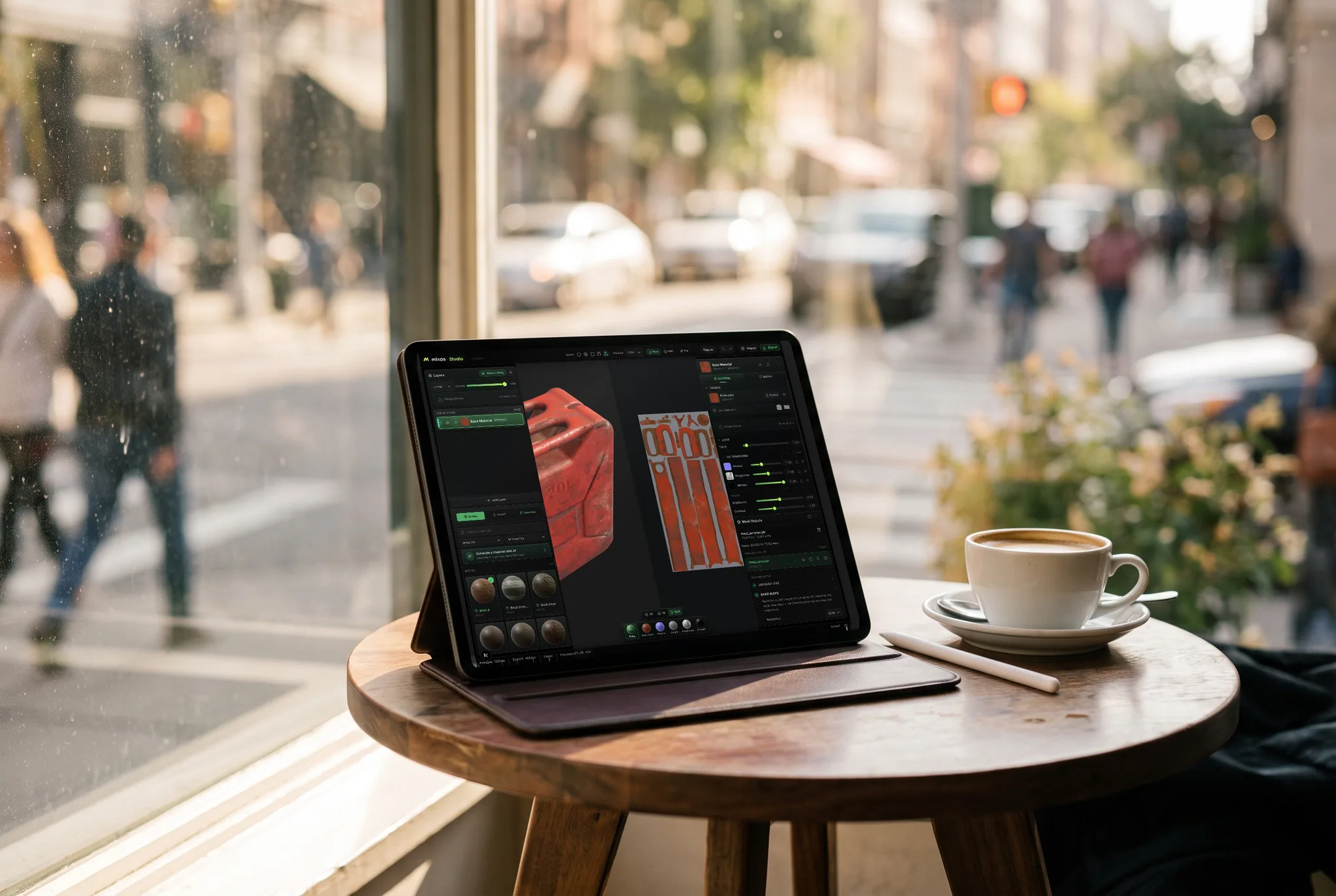
mixos.io/editorA red jerry can textured in the Mixos editor, its shaded 3D view beside the live UV layout, with the layer stack and material controls.

Featured on

  • BlenderNation
  • CG Channel
  • School of Motion
  • Three.js Resources
  • modelinghappy
  • askNK

The Mixos suite

Four apps. One studio.

Every surface job gets its own focused app — painting a model, mixing a tileable material, auto-texturing with AI, or sculpting form from scratch. They share one document, so work moves between them in a click.

Studio

3D texture painting

The full editor. Import a mesh and paint, layer, and mask production PBR materials directly on it — then export clean map sets for any engine.
Blend

Material mixer

Stack and height-blend PBR materials into a seamless, tileable surface — no mesh, no UVs, no setup. One click hands the stack to Studio.

Auto

AI auto-texture

Describe a look in one prompt and Auto textures your whole model — editable PBR maps and a textured GLB, projected over the real geometry.

Mold

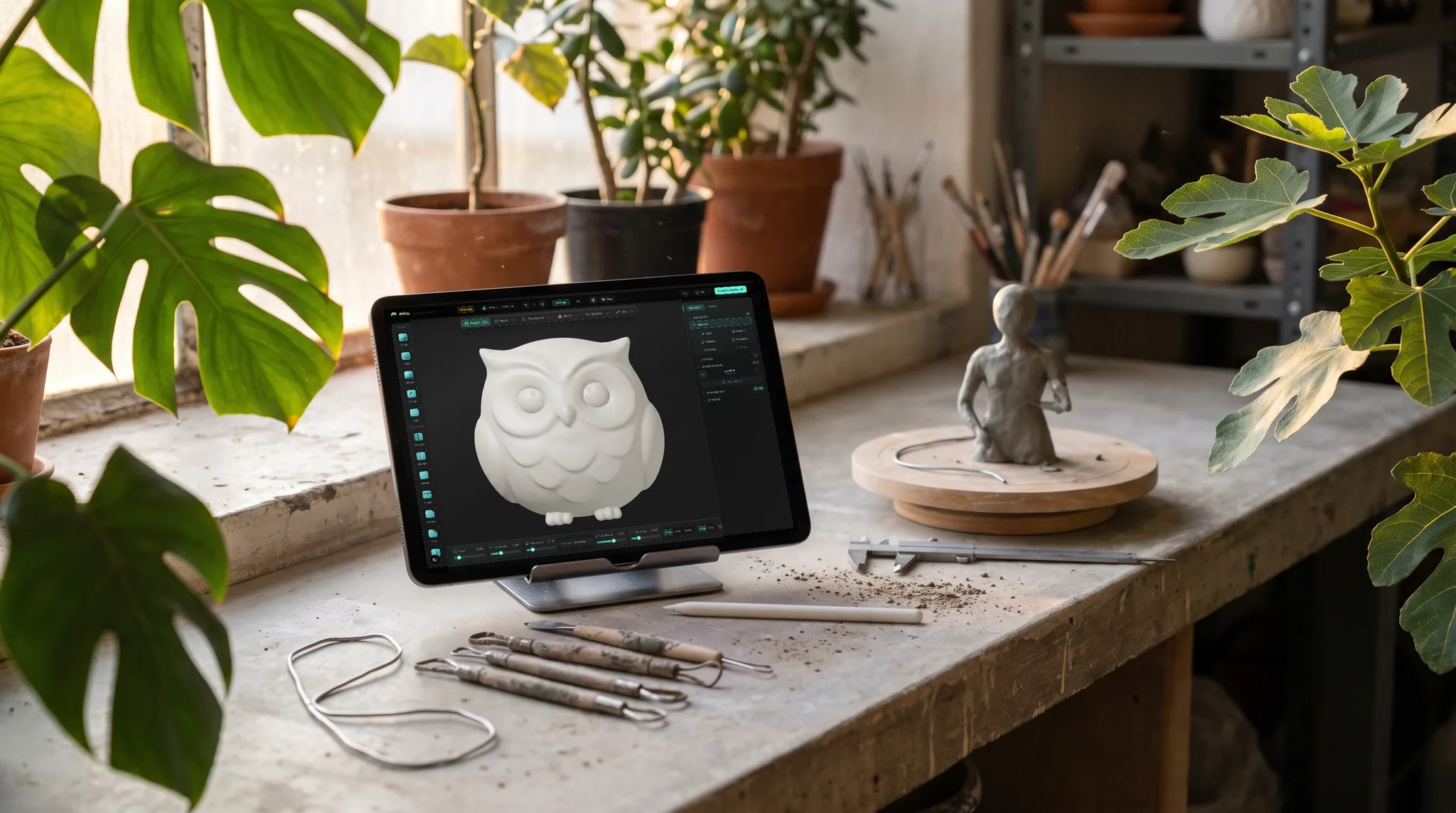
3D sculpting

Sculpt organic form directly on the GPU — subdivide, push, pull, and smooth clay with pressure brushes, then hand the mesh to Studio to texture.

Maps that drop into

  • Cinema 4D
  • Blender
  • Unreal
  • Unity
  • Godot
  • Houdini
  • Maya
  • glTF

See it in action

A walkthrough, from someone who tried it.

Creator askNK took Mixos for a spin and walked through it start to finish.

Video by askNK — go subscribe for more.

The toolkit

Paint, layer, and mask — the way you texture.

Brush detail right onto the mesh, stack blendable layers, and isolate them with masks. Pull in generated or library materials when you want a starting point.

A carved wooden elephant being hand-painted in Mixos: a soft brush lays a green stroke across its flank, with the paint layer sitting above the base material in the stack and a panel exposing the brush's color, opacity, flow and per-channel paint settings.
Paint color, height, roughness & metallic — right on the mesh
A wooden table in Mixos with a Brown Mud Rocks smart material masked to its worn edges: the Masks panel exposes an Edge Wear generator with amount, edge size, contrast, chipping and crevice controls, stacked over a hand-paint layer.
Smart masks add edge wear, grime & curvature — procedurally
A red barrel in Mixos with a faded warning-sign decal being placed on its surface via an on-mesh transform gizmo, with the decal's size, source and color controls in the panel and a community decal library on the left.
Drop on decals, logos & stencils — place, scale, rotate

Texture & mask painting

Paint on the model

Brush detail straight onto the mesh: brush modes, alpha stamps, and projection painting — for both the texture and the masks that place it.

  • Brush & stamp modes
  • Color-ID masks
  • Cross-seam projection

Stack / blend / isolate

Mix layers & masks

Stack blendable layers and isolate them with masks. Mix in materials — metals, paint, stone, leather, wood, fabric — by dragging them onto the stack.

  • Blendable layers
  • Mask compositing
  • Drag-in materials

Prompt to material, mask & brush

Generate with AI

Generate a whole 3D model from a prompt, then texture it — complete tiling PBR materials, seamless textures, weathering masks, brush tips, and decals, every channel editable — or import a photo, scan, or your own mesh.

  • 3D model generator
  • PBR material generator
  • Masks, brushes & decals

Triplanar & tiling

Seamless projection on any mesh — no clean UVs required.

Smart Materials

One click lays down a full layered, pre-masked material.

Height Blend

Materials interlock by height — gravel beds into sand.

Edge wear & weathering

Procedural scratches, grime, and exposed-edge wear.

Mesh map baking

AO, curvature, thickness, and edge maps from your mesh.

Up to 4K export

Organized PBR map sets at production resolution.

Path-traced preview

Flip on Ray for a progressive path-traced render — bounced light, soft shadows, optional depth of field.

Clone tool

Stamp texture from one spot to another across the surface — full material, not just color.

Live Link to your DCC

The desktop app streams maps into Blender, Cinema 4D & Unreal as you paint.

Node materials

Build a material out of nodes.

Wire noise, warps, levels and blends into a graph and it authors every PBR channel at once, evaluated on your GPU as you drag a slider. Feed in your mesh's baked maps and the wear lands where the geometry says it should. Then publish the handful of parameters that matter as variables on the layer, so the finished material stays adjustable without reopening the graph.

  • ~30 nodes
  • Mesh maps as inputs
  • Published settings
  • It's just a layer
The Mixos node editor: a searchable node library on the left, a graph wiring a Billow Noise generator through Normal from Height into the Material Output's Base Colour, Normal, Height and Roughness inputs, and the resulting concrete material previewed live on a 3D sphere beside the Published Settings panel.

Path-traced preview

Path-traced preview.

The Ray toggle switches the viewport to a progressive path-traced render of the frame you're editing — bounced light, soft shadows, and glossy reflections across your whole layer stack. It refines in place while you tune quality, exposure and depth of field.

  • Progressive — refines in place
  • Fast / Balanced / High quality
  • Physical depth of field
A brass oil lantern rendered live with the Mixos Ray path-traced preview — its glass, metal and inner glow lit entirely by the environment — beside the Ray Render panel with Fast, Balanced and High quality presets, sample count and denoise controls. Ray · path-traced

Live Link · desktop app only

Live Link to Blender, C4D and Unreal.

In the free desktop app, Live Link sends your maps to Blender, Cinema 4D, or Unreal each time they change — no export, no upload. With Blender it's two-way: send a model over, texture it, and the maps come back to the same object.

  • Desktop app only
  • One-click plugin install
  • Auto Sync on every change
  • Two-way with Blender
Desktop app · Live Link intoBlenderCinema 4DUnreal
Mixos
An armchair being textured in the Mixos desktop app — leather cushions and wood frame, with the PBR channel strip below
Blender
The same armchair in Blender's viewport with the streamed textures applied to its material
Synced

Material library

Start from 2,600+ ready-made PBR materials.

Bricks, concrete, metal, wood, stone, fabric, leather and more — each a full PBR set. Drag one onto the stack, dial in tiling and roughness, or use it as a base to paint and weather over. Bring your own, too — drop in a material folder, or a whole library of them, and Mixos sorts the base color, normal, roughness, metallic and height maps by filename.

  • Bricks290
  • Wood461
  • Stone354
  • Metal252
  • Tiles283
  • Concrete207
  • Paving255
  • Ground284
  • Fabric164
  • Leather58
  • Asphalt110
  • +8 more
The Mixos material library open over the editor: a searchable grid of PBR material spheres across collections like bricks, concrete, stone and wood, with a large live preview of a rock material and its base color, normal, height and roughness maps — plus a one-click 'Generate a material with AI' option.
2,700 materials · 19 collections
The Mixos workspace with a horse-head model loaded: the layer stack and asset library on the left, a split view showing the shaded 3D model beside its unwrapped UV texture, and the material and masks panel with the mesh's tris, UV unwrap and map bake steps on the right.
Import, unwrap, bake, paint & mask — one workspace

Create from anywhere

Your studio travels with you.

The same editor runs in a browser tab on whatever you're sitting at — a workstation at the studio, a laptop on the train, a Chromebook at school, or an iPad on the couch. Start on one, pick it up on another: your projects live in the cloud, not on one machine.

  • Desktop
  • Laptop
  • Chromebook
  • iPad
  • Phone

Every surface needs a browser with WebGPU (Chrome, Edge, Arc, or Safari 18+). On iPad, Blend opens in its full desktop layout. AI Auto-Texture stays desktop-only — generation needs a desktop-class GPU — and Mold sculpting is included with paid plans.

Why browser-native

Everything a desktop texturing app does — minus the desktop app.

Same production-grade texturing, delivered through a URL: nothing to install, always the latest version, and it runs on any machine — without the license seat or the workstation it's chained to.

MixosMixos
  • Open a URL — texturing in seconds
  • Runs on Mac, Windows, Linux, Chromebook — even iPad & phone
  • Always the latest version, nothing to update
  • Free to author in your browser — no install, no seat fees
  • Hand off a link or a portable project file
  • Real-time WebGPU 2D + 3D viewport
Desktop suites
  • Multi-gigabyte install, drivers, GPU setup
  • Tied to one workstation, per seat
  • Manual version updates and migrations
  • Paid license or seat up front
  • Ship project files plus every dependency
  • A native app you have to keep installed

Prefer a native app after all? Mixos for Mac is a free download — the same editor with every-core bakes, offline support, and a Live Link into Blender, Cinema 4D, and Unreal. Same account either way.

Pricing

Free to create. Pay when you ship.

The whole editor is free — you upgrade only to export production maps, keep a full project library, and generate with AI at volume. One account, one plan — every tier includes all four apps: Studio, Mold, Blend & Auto.

Free

$0forever
  • All 4 apps — Studio, Mold, Blend & Auto
  • The full editor — paint, mask, bake
  • Real-time WebGPU 2D + 3D preview
  • AI material, texture, mask & brush generators
  • 10 trial AI credits
  • 512px watermarked preview export
Start creating
Most popular

Pro

$8.99/ mo · billed monthly
  • Everything in Free, across all 4 apps
  • Export up to 4K, watermark-free
  • 50 AI credits / month
  • 2K AI PBR material generation
  • Full PBR map sets
  • 10 GB cloud storage

Max

$17.99/ mo · billed monthly
  • Everything in Pro, across all 4 apps
  • 200 AI credits / month
  • 50 GB cloud storage
  • Priority AI generation

Credits are only for AI generation — about one per texture, weathering mask, brush, or decal, and a couple for a full PBR material or an Auto-Texture pass. Painting, layering, baking, and export never touch them.

For teams & studios

One bill, a shared library, pooled AI.

Per-seat plans with a shared team library, 150 pooled AI credits per seat, and a single admin for seats & invoicing.

$15 / seat

billed monthly

See team pricing

Teaching a class? Classroom grants are free — paid Mixos for your whole roster for the term, with nothing to install on lab machines.

What you need

If you can open this page, you can almost certainly run it.

  • Browser

    Chrome, Edge, Arc, or Safari 18+

  • Devices

    Desktop, laptop, Chromebook, iPad & phone

  • Graphics

    Any GPU from the last ~6 years

  • Memory

    8 GB RAM (16 GB for 4K)

The 3D editor renders with WebGPU — on a browser that doesn't support it the viewport won't start, so use a current Chrome, Edge, Arc, or Safari 18+ — including on iPad and recent phones. A connection is needed to load, sync, and generate.

Questions

Everything you might be wondering.

The honest answers to what artists ask before they switch.

Do I need to install anything?

No. Mixos runs entirely in your browser — open the editor and you are texturing. No download, no drivers, no license server. (If you want a native app anyway, there's a free desktop version too.)

Which 3D apps and engines does it work with?

Any of them. You export standard PBR map sets — base color, normal, roughness, metallic, height, and opacity — plus a glTF (.glb) and baked maps like AO and curvature, so they drop straight into Cinema 4D, Blender, Unreal, Unity, Godot, Houdini, Maya, and any renderer. The free desktop app goes further with a Live Link that streams your maps into Blender, Cinema 4D, or Unreal while you paint — no export loop at all.

Is there a desktop app?

Yes — Mixos for Mac is a free download (Windows is coming soon). It's the same live editor in a native shell that lifts the browser's limits: bakes on every core, native ML inference, full offline support, and the Live Link to Blender, Cinema 4D, and Unreal. One account covers the app and any browser.

How does a full 3D editor run in a tab?

WebGPU, the modern browser graphics API, gives Mixos desktop-class PBR rendering and GPU compositing — nothing to install, no compromise on the preview. There's even a progressive path-traced preview mode (the Ray toggle) for true bounced light and soft shadows, right in the tab.

Can I texture on an iPad or phone?

Yes. Studio and the Mold sculpt tool run on iPad and phones with a touch-first layout — paint or sculpt with a finger or stylus while the panels reflow into slide-up sheets — and the Blend material mixer runs on phones too. You just need a browser with WebGPU (Safari 18+ on iPad and iPhone, or Chrome). Only AI Auto-Texture stays desktop-only, since generation needs a desktop-class GPU.

What is one-click Auto-Texture?

Describe a look in plain language and Mixos textures your whole imported mesh at once — rendering it from several angles, generating consistent materials, and projecting them back onto your UVs. Then you paint and refine on top.

What can I generate with AI?

From a text prompt: whole 3D models (textured, UV-unwrapped meshes you can paint on immediately), complete tiling PBR materials (real base color, normal, roughness, metallic, and height maps), seamless textures, grayscale weathering masks, alpha brush tips, and decals — plus full-mesh Auto-Texture. Every plan can use the generators; Pro and Max also unlock 2K material generation and the two highest-fidelity 3D generators.

What are AI credits used for?

Only AI generation spends credits. A texture, weathering mask, brush, or decal is 1 credit; a full PBR material or an Auto-Texture pass costs a couple, and native 2K materials a little more. Generating a 3D model is the priciest at 4-16 credits depending on the generator, since 3D costs us several times what an image does. Everything else in the editor — painting, layering, masking, baking, and live preview — is always free and never touches your credits. A free account gets a one-time trial pool; Pro and Max refresh a larger pool every month.

Can I bring my own meshes and images?

Yes. Import your mesh (GLB, glTF, FBX, OBJ) to paint and bake on it, and bring photos or scans as material sources.

Is it free?

Yes — open the editor and texture for free, and a free account includes trial credits for the AI generators. Paid plans unlock high-resolution export, the project library, 2K material generation, and a refreshing monthly pool of AI credits.
Mixos

Get started

Open a tab. Start texturing.

No download, no setup, nothing to license. Auto-texture your first model and build real PBR materials in minutes.