No addon, no local server
Nothing is installed on either side. There is no addon version to match against a Blender release, no port to keep open and no Python environment to repair — the connector is a URL and the app is already running in a tab.
Blender MCP alternative
Driving 3D from an AI assistant usually means installing Blender, dropping an addon into it and running a local MCP server — three things to set up and keep in step, on one machine. Mixos is the same capability with none of that: the 3D app is a browser tab and the connector is a URL you paste into Claude or ChatGPT.
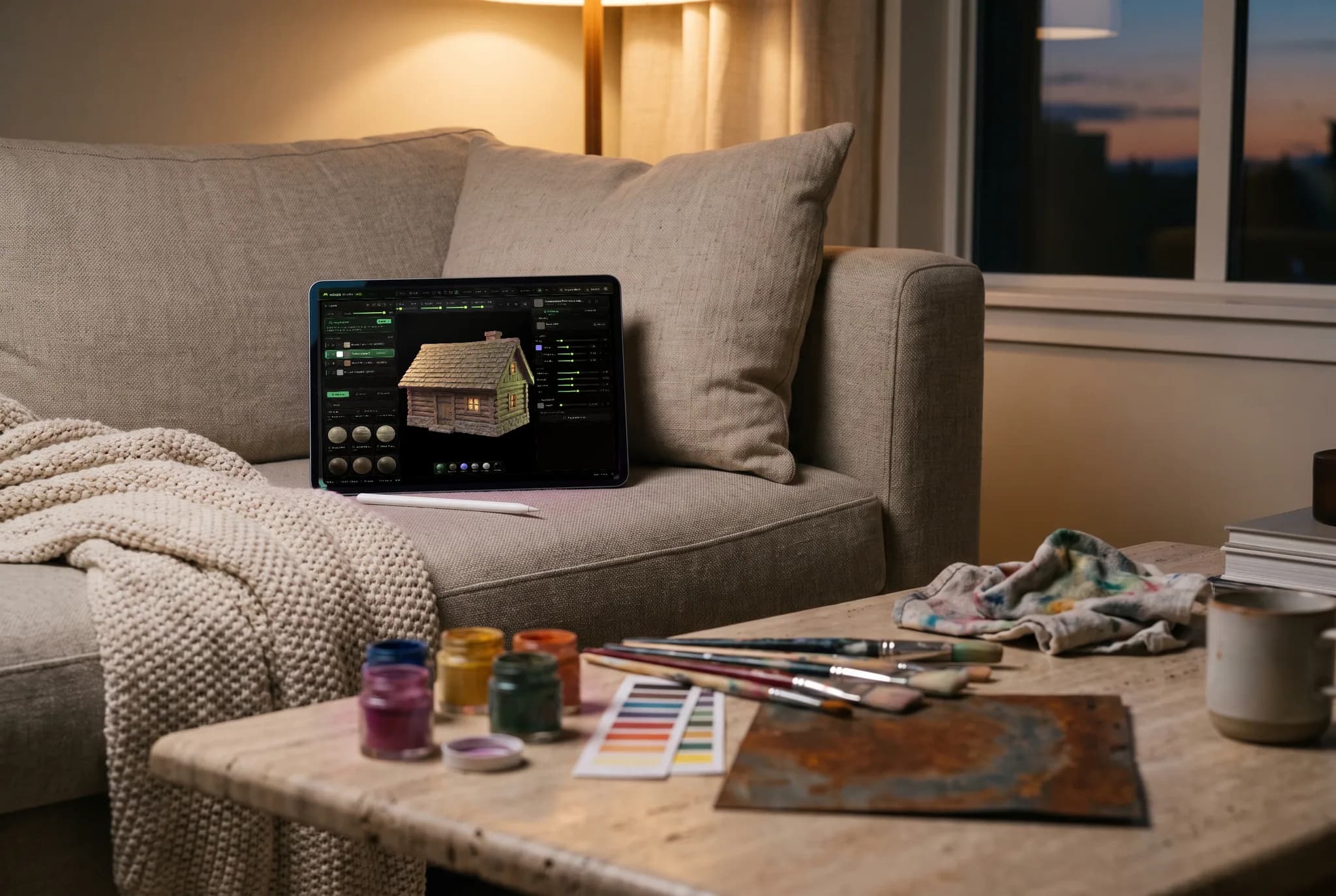
Nothing is installed on either side. There is no addon version to match against a Blender release, no port to keep open and no Python environment to repair — the connector is a URL and the app is already running in a tab.
A local bridge only works while that computer is on and that server is running. This one follows your account, so the same assistant reaches your scenes from a laptop, a borrowed desktop or a Chromebook the moment you sign in.
Claude and ChatGPT both connect, with separate permissions and one shared tab. Revoke either without touching the other — and neither needs an API key, because the model runs on the plan you already pay for.
The same connection reaches sculpting and texture painting as well as the scene: 420+ commands across Studio, Mold and Paint, with materials, lighting, rigging, animation and a path-traced render at the end.
Why Mixos
Blender is a superb piece of software and this page is not an argument against it. The comparison is narrower: if what you want is an assistant that can build and change a 3D scene for you, the local-bridge route asks you to install a desktop application, install an addon into it, run a server alongside it, and keep those three versions compatible. That is a setup you maintain, and it only exists on the machine you built it on.
The browser route asks for a URL. You add the connector in your client's settings, approve it once, open a scene and press Connect. Nothing is installed, nothing has to match a version, and the connection is tied to your account rather than to a computer — so it still works on the next machine you sign in to, including a Chromebook or an iPad.
The trade is real and worth stating: a desktop bridge drives an application with decades of features and every addon you have installed, and it runs entirely on your own hardware. Mixos runs in a browser tab on WebGPU, so the ceiling is different — but the whole command layer is exposed, deletes stop and ask before they run, and everything the assistant does is an ordinary undo step. If you have Blender set up and working, keep it. If you bounced off the setup, this is the version without one.
No. Mixos is its own 3D application and it runs in a browser tab, so there is nothing on your machine for the connector to talk to — the assistant reaches the tab directly. You can still export to Blender at any point; GLB, glTF, OBJ, FBX and USDZ all come out.
No. The connector is a hosted MCP endpoint at a fixed URL, so there is no process to start, no port to open and nothing to restart after a reboot. The only thing that has to be running is the browser tab your document is in.
For the scene-building loop, largely yes: meshes and modifiers, booleans, materials and node graphs, lights and cameras, rigging and mocap, a real timeline, and a path-traced render. What it cannot do is reach Blender's own addons or its longer tail of specialist tools — that is the genuine cost of not being Blender.
Connecting is free on every Mixos plan, and the assistant runs on your existing Claude or ChatGPT subscription rather than an API key. A paid Mixos plan buys production export, AI generation credits and cloud storage — the modelling itself is free.
Yes, in both directions. Import GLB, glTF, OBJ, FBX or STL into Mixos, and export the same formats back out with materials and textures intact — so a scene the assistant blocks out here can be finished in Blender.
Read next
The whole pass, from import to exported maps.
The maps a modern material is made of, and what each one does.
Why the same texture reads bigger on one model than another.
Drop the files in and see the material lit, in the browser.
Keep exploring
MCP 3D modeling
Claude 3D modeling
Blender alternative
Online 3D modeling

Paste one URL into Claude or ChatGPT and start asking for scenes — nothing to install on either side.