Voxel remesh makes it watertight
The single most common reason a sculpt fails to print is a mesh that isn't closed. One remesh rebuilds the whole surface as a single continuous shell, so the slicer can tell inside from outside.
Sculpting for 3D printing
A model that prints has requirements a render never has: one closed watertight surface, no gaps, nothing too thin to survive the build. Sculpt the shape with pressure brushes, remesh it watertight in one operation, decimate it to a sane size, and export the STL your slicer wants — in a browser tab.
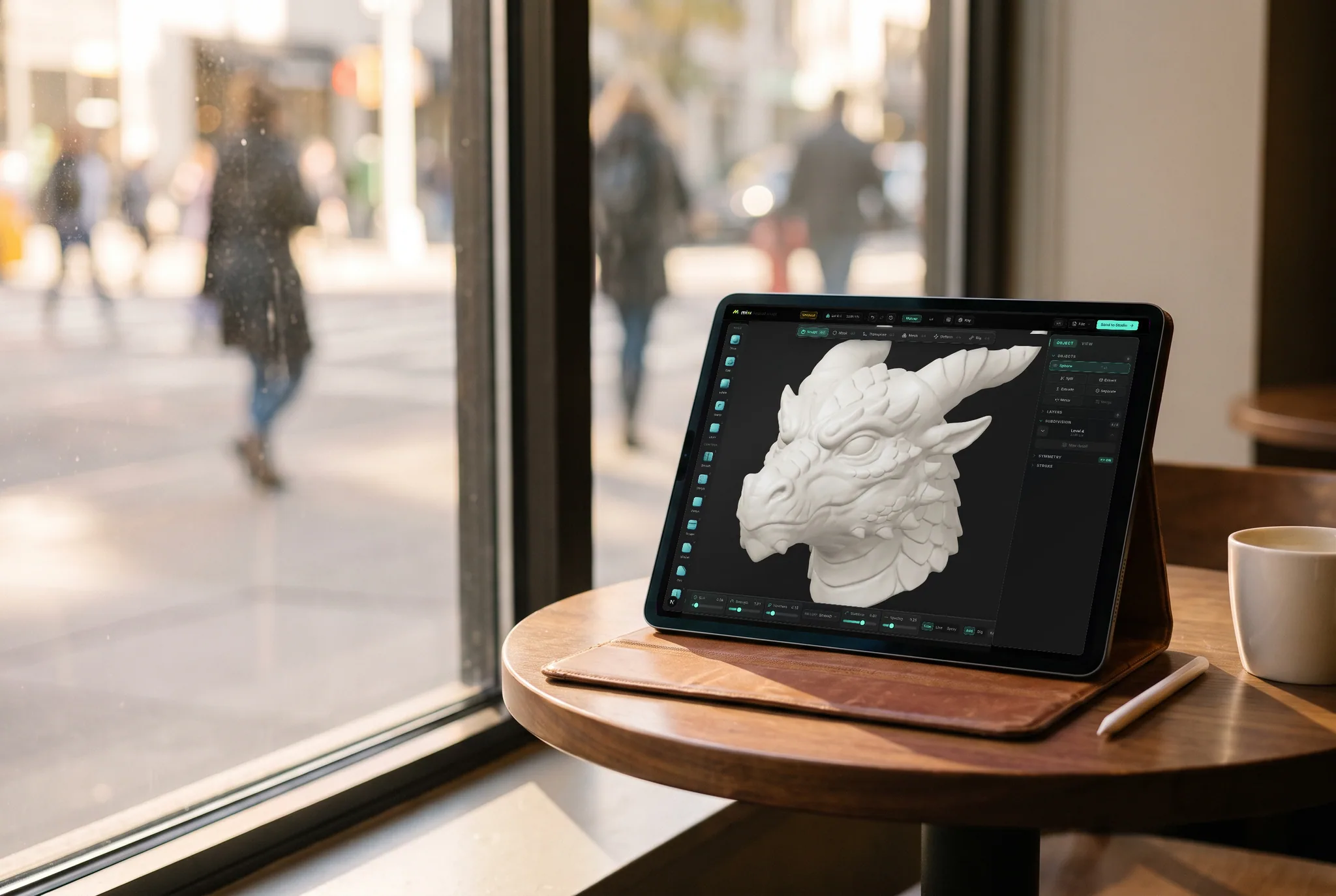
The single most common reason a sculpt fails to print is a mesh that isn't closed. One remesh rebuilds the whole surface as a single continuous shell, so the slicer can tell inside from outside.
Miniatures, busts, creatures, terrain and ornaments are exactly what CAD is bad at. Push, pull and carve the form by eye with clay, crease, pinch and trim brushes instead of fighting a parametric modeler.
Slicers don't want millions of triangles. Decimate cuts the count while holding the silhouette, keeping density where curvature is high — a file your slicer opens in seconds rather than minutes.
STL is the universal printing format and fuses everything into one solid, which is what a slicer expects. OBJ and GLB keep your objects separate and named if the model is heading somewhere else first.
Why Mixos
Three things, and they are easy to satisfy if you know them in advance and painful to retrofit if you do not. The first is that the mesh must be watertight — one closed surface with no holes, no gaps and no faces that pass through themselves. A slicer works by asking whether a given point is inside or outside the model, and an open mesh makes that question meaningless. This is the single most common cause of a failed print, and a voxel remesh solves it in one operation by rebuilding the sculpt as a continuous shell.
The second is detail scale. Fine work below roughly 0.4 mm at final size will not resolve on a filament printer no matter how good it looks on screen, so pores and fine scratches are wasted effort unless you are printing in resin — which is exactly why tabletop miniatures are resin-printed. Sculpt detail at the size it will actually be seen.
The third is fragility. Thin projections — a sword blade, a whisker, an outstretched finger, an antenna — will snap in your hand even when they print successfully. If something looks delicate on screen it is too delicate in plastic, so thicken it before exporting, however wrong that looks in the render. Overhangs and undercuts need support material or they will fail mid-print.
The workflow that follows is short. Sculpt the form and the detail first and ignore print preparation entirely while you work — it is a finishing step, not a constraint to sculpt under. Then remesh to close the surface, inflate or build up anything thinner than about 2 mm at print scale, decimate if the triangle count is unwieldy, and export STL. Sculpting, remeshing and decimating are all free; downloading the STL is what a paid plan covers, so you can take a model to print-ready before deciding.
For organic subjects — miniatures, busts, creatures, terrain — a sculpting tool beats CAD, because you are judging shape by eye rather than by measurement. Blender and ZBrush are the established desktop options. Mold runs in a browser with no install, sculpts with pressure brushes, remeshes watertight in one operation and exports STL. For mechanical parts with real tolerances, use a parametric CAD tool instead — that is not what sculpting is for.
Run a voxel remesh. It discards the existing topology and rebuilds the surface as a single closed shell, which is exactly the manifold geometry a slicer needs. Do it after the form is finished, since a remesh also discards your subdivision-level history.
As a rule of thumb, nothing below about 2 mm at final scale on a filament printer, and detail below roughly 0.4 mm will not resolve at all. Resin printers hold much finer detail, which is why miniatures are printed on them. If a part looks fragile on screen it will break in your hand — thicken it before exporting.
Yes. Mold exports STL, OBJ, GLB and FBX. STL fuses every visible object into one solid, which is what a slicer expects — hiding an object is how you leave it out of the export. STL export is part of a paid plan; sculpting, remeshing and decimating are free.
Probably, and it rarely matters visually. Slicers slow down badly on multi-million-triangle meshes while the print itself resolves far less detail than that. Decimate before exporting — it keeps the silhouette and holds density where curvature is high, which is all the printer can reproduce anyway.
Keep exploring
3D sculpting software
Sculpting for beginners
ZBrush alternative
Sculpting on iPad

Organic form with pressure brushes, one operation to make it watertight, and an STL your slicer will open — free to sculpt, in a browser tab.