It builds, it does not describe
“A low table with four tapered legs, and a bowl on it” comes back as objects in your outliner that you can select, move and edit — not as instructions for you to follow or a mesh you have to import.
ChatGPT 3D modeling
Add Mixos as a custom connector and ChatGPT can build in a browser tab you have open: geometry, materials, a light rig, a camera move, a path-traced render. It runs on your own ChatGPT plan — Plus, Pro, Business, Enterprise or Edu — with no API key and nothing metered here.
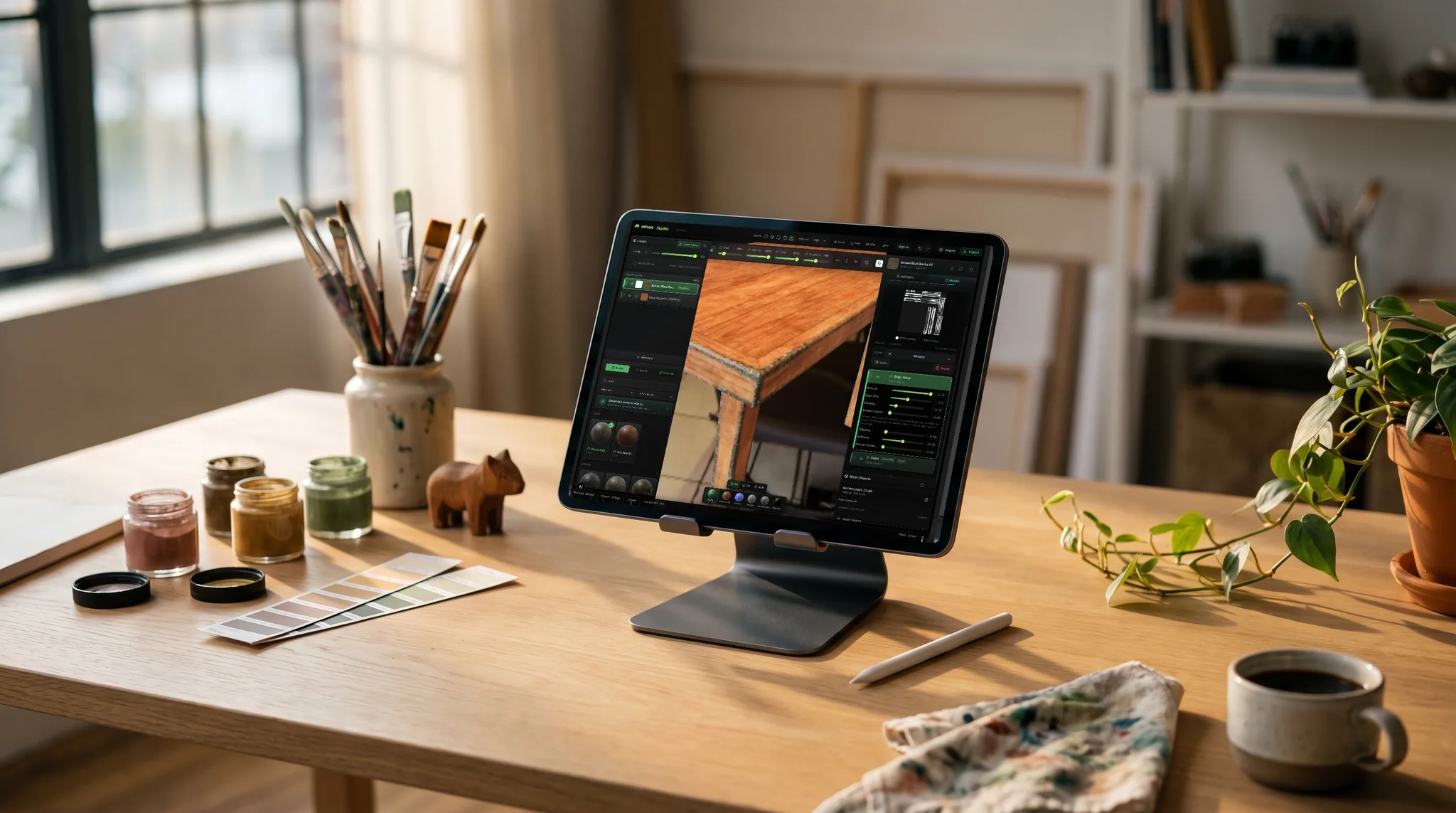
“A low table with four tapered legs, and a bowl on it” comes back as objects in your outliner that you can select, move and edit — not as instructions for you to follow or a mesh you have to import.
ChatGPT queries what is in the document, what is selected and what the viewport currently looks like before it acts — so “frame the hero object from a low angle” resolves against your actual scene rather than a guess.
ChatGPT lists what the connector may do when you add it, so you can refuse AI generation — the only permission that spends credits — before you ever reach the Mixos approval screen. It has to be granted in both places to take effect.
Materials and node graphs, point, spot, area and IES lights, cameras, physics, cloners and particles, rigging with mocap retargeting, a real timeline, and a path-traced still or turntable at the end.
Why Mixos
The useful version of this is not “generate me a finished scene”. It is the blocking and the fiddly parts — laying out a room, arraying a hundred instances along a curve, building a three-point rig and warming the key, retiming an animation, turning a reference photo into a set. You describe the change, it happens in your tab, and you carry on working directly if it is faster to drag something than to say it.
That works because ChatGPT is handed the app's real command layer rather than a scripting sandbox: the same operations the menus and keyboard shortcuts run, with the same validation. It reads before it acts — the scene contents, the current selection, a viewport capture — and reports what actually happened afterwards, so when Studio clamps a value or refuses an operation, that is what comes back rather than a claim of success.
One thing worth knowing up front: ChatGPT reads the tool list once, when the connection is made, and Mixos widens that list as your document grows — add a cloner and the cloner commands become available. A long conversation can therefore be working from the list it was handed at the start. Pressing Refresh on the connector and starting a new chat picks up the rest; inside a conversation, asking it to search for what it needs still reaches everything.
Custom connectors are available on ChatGPT Plus, Pro, Business, Enterprise and Edu, on the web. The model runs on your own subscription, so Mixos never asks for an API key. On a Business or Enterprise workspace an admin may need to allow custom connectors first.
Turn on Developer mode, add a custom connector with the Mixos URL, approve it once, then press Connect in a Mixos tab. The full walkthrough — including where Developer mode lives — is on the ChatGPT connector page.
It reads the tool list when the connection is made and does not re-read it on its own, so a long conversation can be looking at an older list. Open the connector, press Refresh, then start a new chat. You do not have to remove and re-add it.
All three. The connector reaches Studio, Mold and Paint, and it is handed the tools of whichever app the connected tab is running — so connect Mold and it gets brushes and remeshing rather than the scene graph.
Yes, and both at once. They are separate grants with separate permissions driving the same connected tab, and revoking one leaves the other working.
Read next
Vertices, edges and faces — the box-modelling fundamentals.
Which of the two approaches fits the thing you're making.
Which format keeps materials and which throws them away.
Why the same texture reads bigger on one model than another.
Keep exploring

Add the connector in ChatGPT, press Connect in a Mixos scene, and describe what you want built.