Mold vs ZBrush
Mold vs ZBrush, compared honestly.
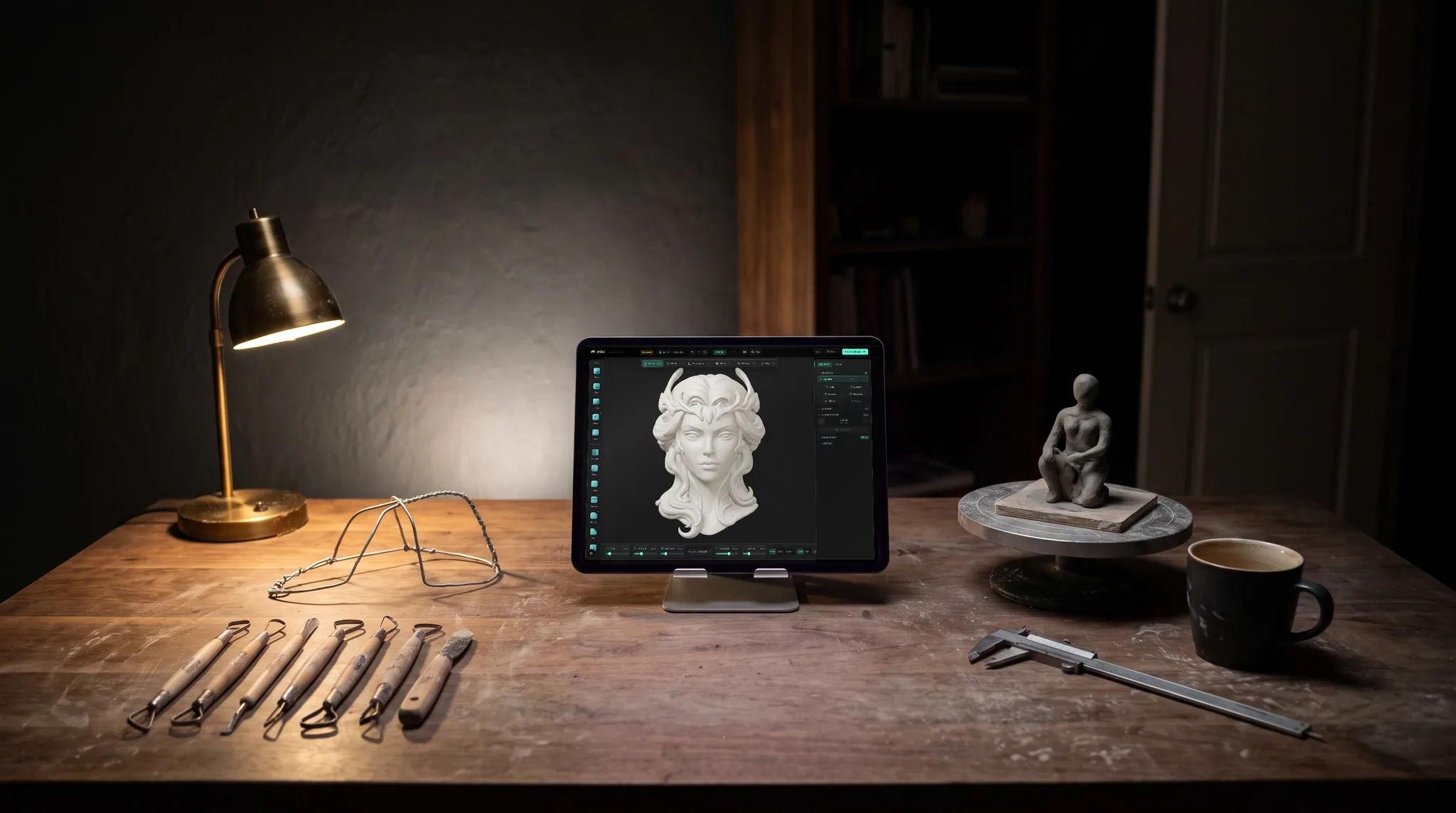
Both are brush-driven digital sculpting tools — push, pull, smooth, and crease organic form with symmetry, masking, and million-polygon meshes. ZBrush is the desktop standard with two decades of depth; Mold runs the same core workflow on the GPU in a browser tab, then hands the sculpt straight to a PBR texture painter. Here's where each one wins.
Feature by feature
Mold vs ZBrush, line by line.
A lime check marks the tool with the edge on each row. Where it's a wash, neither gets one — including the rows ZBrush wins.
| Feature | Mold | ZBrush |
|---|---|---|
| Runs in | Any WebGPU browser — Mac, Windows, Linux | Desktop app (Windows, macOS) + iPad version |
| Install & setup | None — open a URL and sculpt | Multi-GB install + license activation |
| Pricing | Free to sculpt; mesh export from $8.99/mo | Subscription via Maxon (roughly an order of magnitude more) |
| Core brush sculpting | Draw, inflate, grab, flatten, pinch, crease — pressure-sensitive | Hundreds of brushes, deeply configurable |
| Dynamic topology | Yes — tessellates under the brush | Yes — Sculptris Pro |
| Multiresolution subdivision | Yes — sculpt broad at low levels, detail at high | Yes — the reference implementation |
| Masking & symmetry | Yes — masks, mirror strokes, radial symmetry | Yes — plus polygroups and selection depth |
| Remeshing | Voxel remesh + quad remesh built in | DynaMesh + ZRemesher — the benchmark |
| Vertex paint / polypaint | No — sculpts hand off to Mixos Paint for full PBR texturing | Yes — polypaint on the mesh |
| Sculpt → PBR texture pipeline | One click into Mixos Paint with fresh UVs | Export to a separate texturing app |
| Hardware it runs on | Any machine with a WebGPU browser — including modest laptops and iPads | A capable workstation; CPU-bound engine |
| Works offline | No — runs in the browser | Yes |
So which should you use?
ZBrush is Maxon's industry-standard desktop sculpting app — the deepest brush and topology toolset in the category and the default for character and creature work in film and games.
Choose Mold if…
- You want to sculpt without installing or licensing anything — on whatever machine you have, including an iPad.
- Texturing is part of your pipeline: Mold unwraps the sculpt and opens it in Paint's PBR painter in one click.
- You're learning digital sculpting and want the fundamentals — brushes, symmetry, masking, subdivision — without ZBrush's famously steep interface.
- A Mixos plan from $8.99/mo fits your budget better than a ZBrush subscription.
Choose ZBrush if…
- You sculpt professionally and need the deepest brush, polygroup, and ZRemesher toolset in the industry.
- Your studio pipeline is built around ZBrush files, plugins, and offline workstations.
- You need polypaint, fibermesh, hard-surface booleans, or the broader ecosystem of a two-decade-old tool.
The bottom line
The sculpting fundamentals, minus the workstation
ZBrush earned its place — no other tool matches its brush depth, and ZRemesher is still the retopology benchmark. But that power comes with a desktop install, a subscription that costs several times a Mixos plan, and an interface that famously takes months to feel at home in.
Mold keeps the part that matters — direct, pressure-sensitive brush sculpting over a subdivided mesh, with masking, symmetry, dynamic topology, and multiresolution levels — and runs it on the GPU in a browser tab. The engine displaces vertices on the same WebGPU device that renders the viewport, so dense meshes stay responsive without a workstation.
The other difference is what happens after the sculpt. ZBrush hands you a high-poly mesh and wishes you luck in your texturing app. Mold unwraps the sculpt and opens it in Mixos Paint with fresh UVs, ready to paint layered PBR materials — the model-to-textured-asset pipeline stays in one browser. If you sculpt characters for a living, ZBrush is still the tool. If you want real sculpting fundamentals with zero install and a built-in path to textured, render-ready assets, Mold is the lighter way in.
Frequently asked questions
Is Mold a free ZBrush alternative?
Sculpting in Mold is free — every brush, subdivision level, dynamic topology, remeshing, masking and symmetry, on a free Mixos account, with no time limit. Exporting the finished mesh as GLB, OBJ, or STL is on a paid plan from $8.99/mo, which is still a fraction of a ZBrush subscription. So you can learn, block out, and finish a sculpt for nothing, and pay only when you need the file.
Does Mold have dynamic topology like Sculptris Pro?
Yes. Mold tessellates the mesh under the brush as you sculpt, adding resolution only where you're working, and can voxel-remesh or quad-remesh when you want an even surface — the same roles Sculptris Pro and DynaMesh play in ZBrush.
Can Mold handle millions of polygons in a browser?
Yes — multiresolution subdivision takes a base mesh into millions of triangles, and the sculpting engine runs on the GPU via WebGPU, so strokes stay smooth on dense meshes without desktop-app round-trips.
Can I paint my sculpt like ZBrush's polypaint?
Not in Mold itself — instead, one click unwraps the sculpt and opens it in Mixos Paint, a full layer-based PBR texture painter with smart materials, masks, and baking. You get complete texture maps rather than vertex colors.
What hardware does Mold need?
A browser with WebGPU — current Chrome or Edge on any desktop OS, no discrete GPU required for moderate meshes. It also works with touch and pencil input on iPad.
Try it yourself. No install.
Open a tab and sculpt — brushes, subdivision, and symmetry on the GPU, nothing to download, free to use, and you can decide for yourself how it compares.