Around thirty nodes
Noise and gradient generators, blur, levels, curves, hue/saturation, warps, mirrors, blends, normal-map tools, channel split and combine, and math.
Node-based material editor
Wire generators, filters and blends into a graph and it authors every PBR channel at once. It evaluates on the GPU as you work, reads your mesh's own baked maps, and drops out the other side as an ordinary, paintable layer.
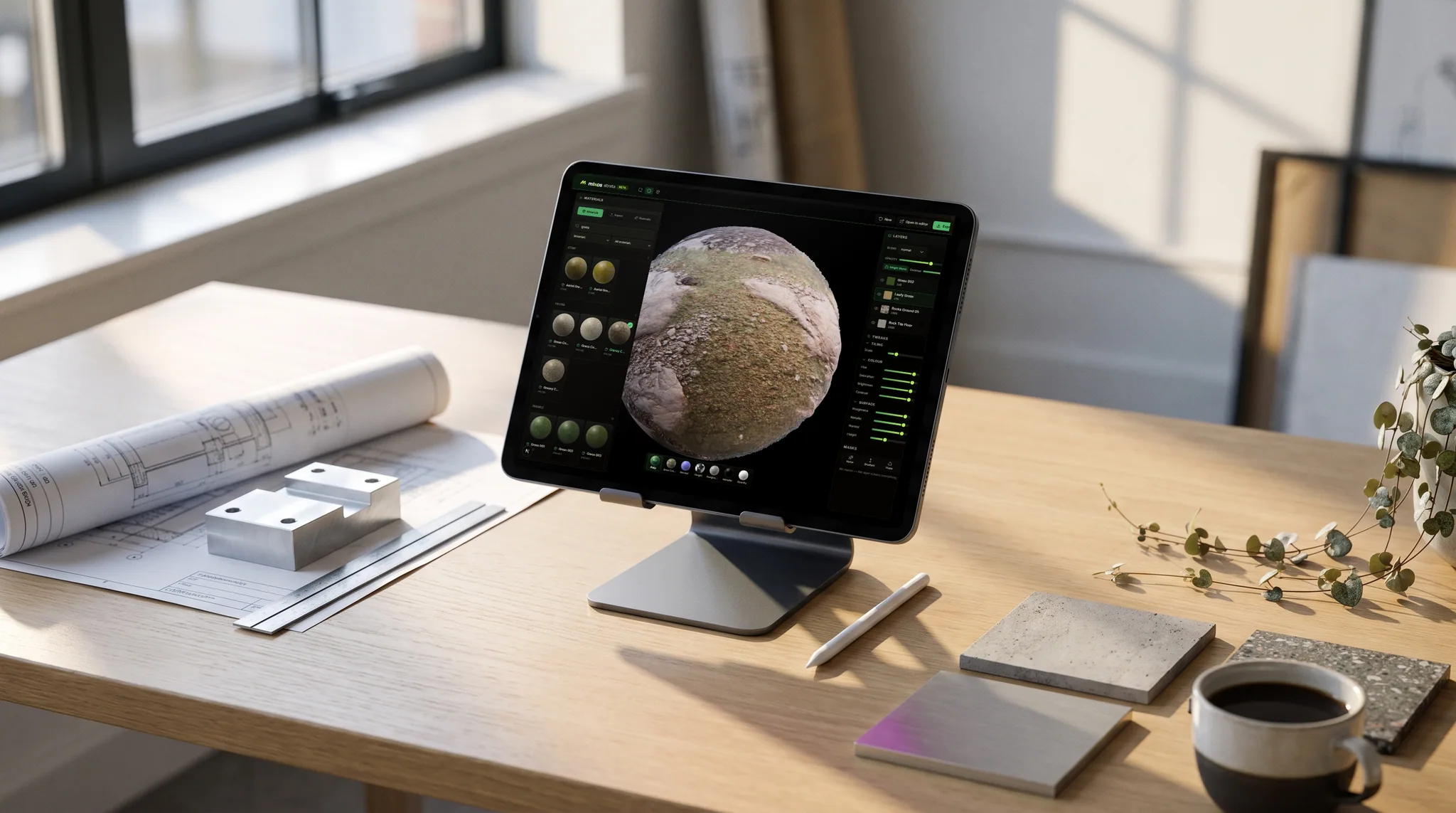
Noise and gradient generators, blur, levels, curves, hue/saturation, warps, mirrors, blends, normal-map tools, channel split and combine, and math.
Drag a parameter and the preview refines immediately, then settles to full resolution when you stop. No bake button between you and the result.
Ambient occlusion, curvature, cavity, edge wear and slope are graph inputs, so a material can respond to the shape it's applied to.
Publish any node's parameter on the layer — tile size, wear amount, a color — and save the graph to your library. It reopens editable, variables and all, on the next model.
Why Mixos
A node graph is the natural way to build a material that has rules: rust that follows curvature, tiles whose grout darkens with occlusion, paint that chips along edges. Rather than painting the result by hand, you describe how it's made — and then change your mind cheaply, because every step stays live.
Mixos's editor covers the working set: fractal noise and gradients to generate from, blur, levels, curves and hue/saturation to shape, directional and domain warps to break up regularity, blends and height blend to combine, normal-map tools, channel split and combine, and plain arithmetic. Any node's output can drive any input, and the whole graph resolves to the PBR channels your model renders with.
What makes it different from a standalone graph tool is the last step: there isn't one. The graph is a layer, so it takes masks and blend modes, sits under painted detail, exports in the same map set, and updates the viewport as you edit.
It also has a public face. Any parameter in the graph can be published as a variable: click the slider glyph beside it and it joins the material's Published Settings, where you name it, group it, order it, and give it a sensible range. Those variables then appear on the layer's own panel in the main editor — so the graph is the implementation and the published settings are the interface, and a finished material can be retuned months later, by you or by whoever you hand it to, without opening the graph at all.
It's a way of building a material as a graph instead of a painting: nodes generate patterns, filters shape them, blends combine them, and the graph's output becomes the surface's PBR channels. Because every step stays editable, changing one parameter re-derives the whole material.
No — the node editor is free on every account. Paid plans add watermark-free 4K export, cloud project storage, and more AI credits.
Not at all. The node editor is an optional layer type; you can texture entirely with the 2,600+ ready-made materials, painting, and smart masks, and open a graph only when you want procedural control.
Yes. Once you've baked mesh maps, ambient occlusion, curvature, cavity, edge wear and slope are all available as graph inputs — the standard way to make wear and dirt settle where the geometry implies.
Yes — Mixos calls them published settings. Click the slider glyph beside any node parameter and it becomes a variable on the material, which you can rename, group, reorder and give its own range. Published settings appear on the layer's panel back in the main editor, so a finished material stays adjustable without reopening the graph.
Read next
Building a surface from rules instead of pixels.
What the two greyscale maps each control.
Free browser packer — occlusion, roughness and metallic into one file.
Drop the files in and see the material lit, in the browser.

No download, no setup, nothing to license. Auto-texture your first model and build real PBR materials in minutes.