Roughness and metallic maps, explained
Roughness and metallic are the two maps that do the most to define what a PBR surface feels like — plastic or polished, rusted iron or painted steel. They're separate channels with separate jobs, and they work together.
By Mixos
The short answer
The roughness map controls how blurry or sharp a surface's reflections are: black (0) is a mirror, white (1) is fully matte. The metallic map is almost binary — white (1) means metal, black (0) means non-metal. Most of a material's character comes from varying roughness; metallic stays mostly 0 or 1, with in-between values reserved for transitions like partly-rusted metal.
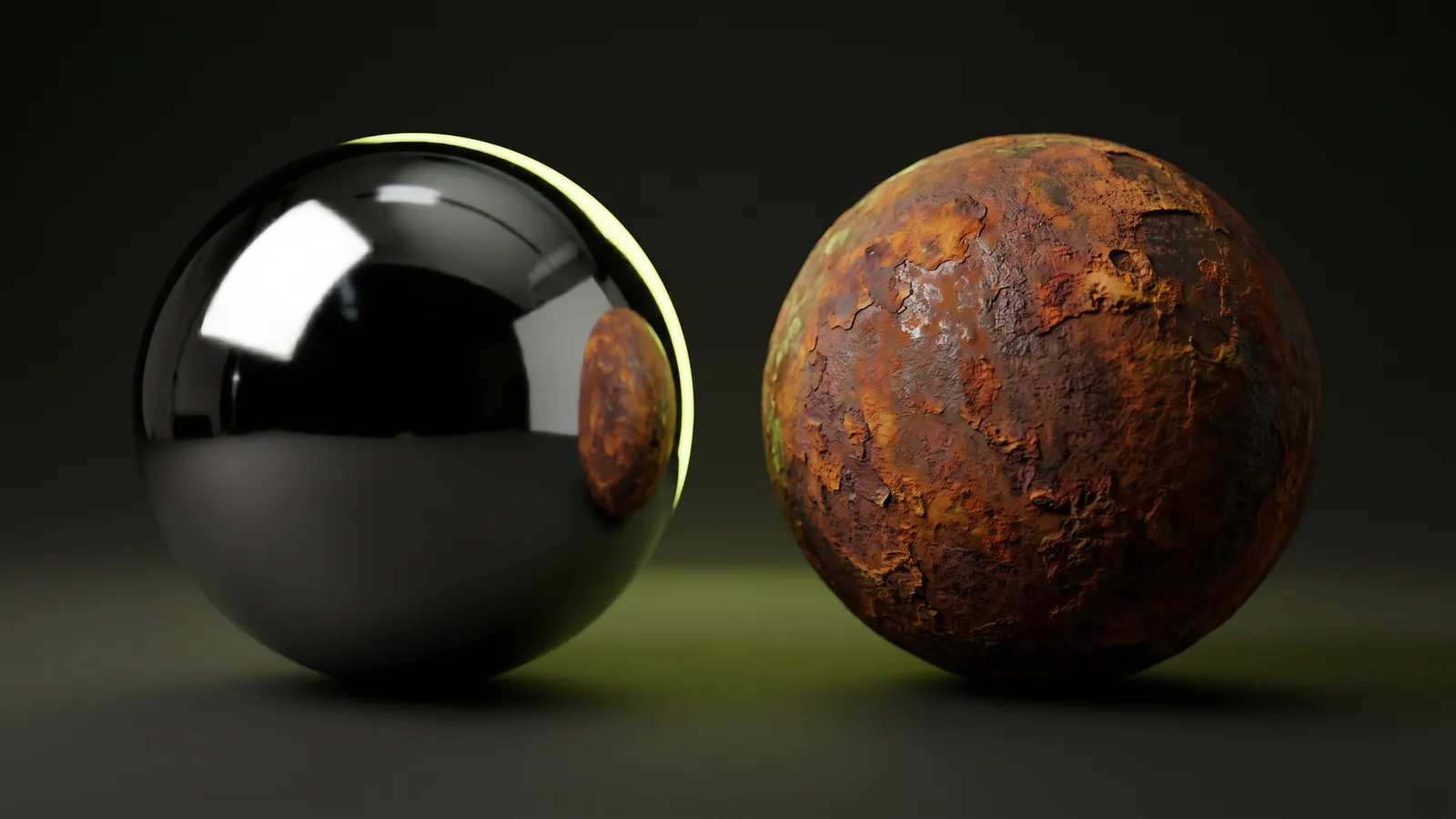
What roughness does
Roughness describes microsurface detail too small to model — the micro-scratches that scatter reflected light. Low roughness gives tight, sharp reflections (polished metal, glossy paint); high roughness gives soft, spread-out reflections (chalk, raw wood).
It's the single most expressive PBR channel. Varying it across a surface — fingerprints, water spots, worn patches — is what sells realism, far more than the base color alone.
What metallic does
The metallic map tells the renderer whether to treat a pixel as a metal (conductor) or a non-metal (dielectric). Metals reflect their base color and have almost no diffuse component; non-metals reflect white-ish highlights and show their diffuse color.
Keep it mostly pure black or pure white. Gray metallic values are physically rare and usually a mistake — the main exception is material boundaries, like chipped paint revealing steel underneath.
How they work together
A surface reads as “rusted iron” because metallic marks the bare-metal areas while roughness makes the rust dull and the clean metal sharp. The two maps are usually masked from the same wear pattern.
Authoring roughness and metallic in tandem — not in isolation — is the core of believable PBR texturing.
Sources and further reading
Frequently asked questions
What does the roughness map control?
How sharp or blurry reflections are. Black is glossy and mirror-like, white is matte. It's the most expressive channel for conveying how a surface feels.
Should the metallic map use gray values?
Rarely. Metallic should be almost pure black (non-metal) or pure white (metal). Gray only appears at transitions, like rust or chipped paint.
Is roughness the same as Unity's smoothness?
They're inverses. Unity uses smoothness = 1 minus roughness, so a rough surface has low smoothness. Many tools (including Mixos) export roughness; invert it for Unity.

Dial in roughness and metallic with live 3D feedback in Mixos — see reflections change as you paint.